

 Tiếng Việt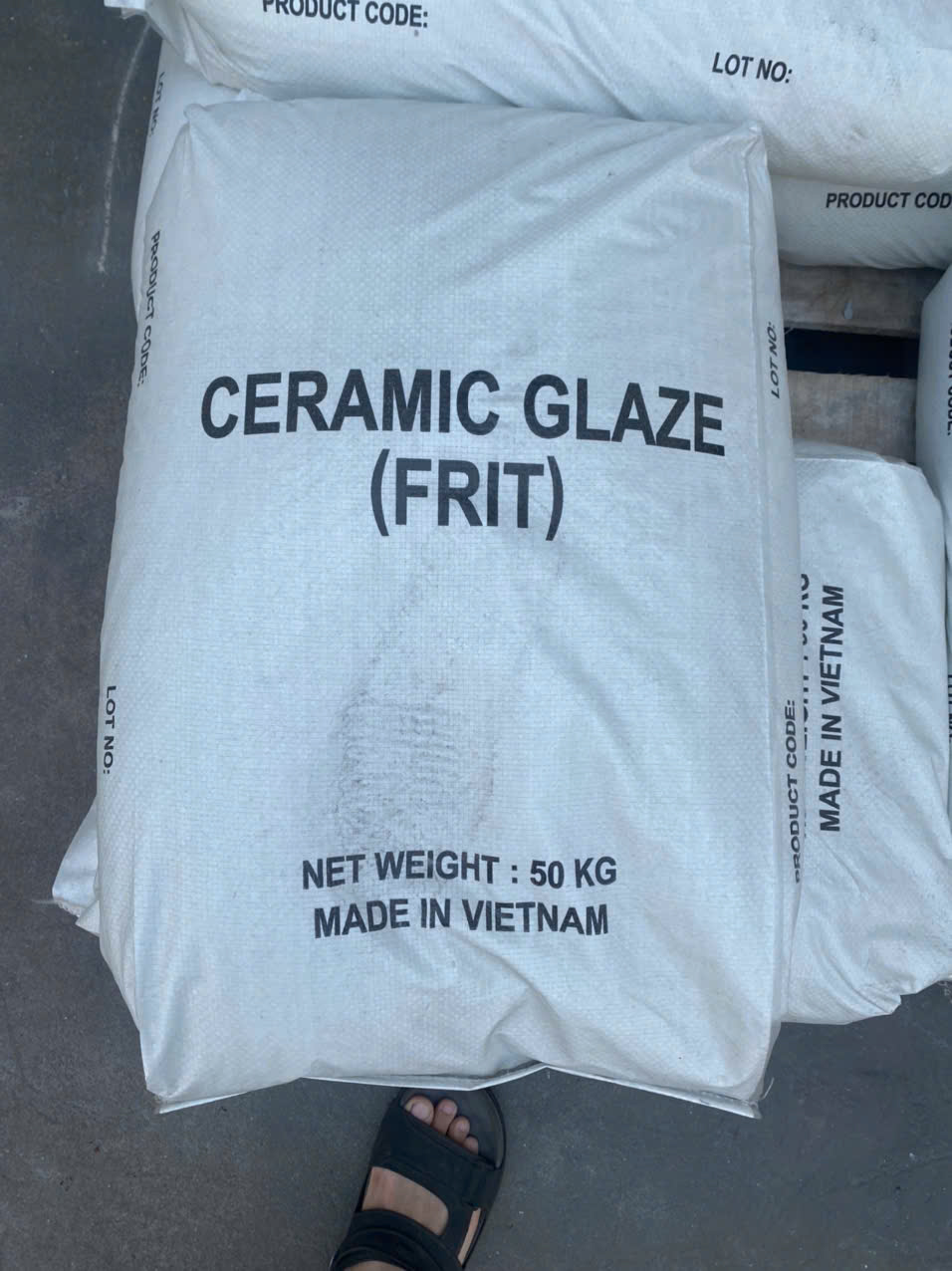
LOW-FIRE BORON FRIT (BORON FRIT / B₂O₃ FRIT)
1. Definition
Boron Frit is a type of low-fire frit in which Boron Oxide (B₂O₃) is the primary functional oxide.
It is produced by melting B₂O₃ together with SiO₂ and other flux oxides, followed by rapid quenching to form a stable glassy structure, which is then finely ground for use in glaze formulations and ceramic materials.
2. Function / Role
Boron Frit acts as a powerful flux oxide in ceramic and glaze systems, providing the following functions:
- Reduces the melting temperature of frits and glazes
- Promotes early liquid-phase formation, enabling smooth glaze flow at lower temperatures
- Improves surface gloss and glaze smoothness
- Stabilizes fast-firing processes and suppresses unwanted crystallization
- Helps save energy and shorten firing cycles
3. Key Characteristics
- High B₂O₃ content, chemically bonded within a silicate glass network
- Low to medium working temperature range (approx. 1000–1190°C)
- Insoluble in water, safer than free borax or boric acid
- Excellent melt fluidity, good leveling behavior, reduced defects such as pinholes and crawling
- Adjustable coefficient of thermal expansion (CTE) to match ceramic, porcelain, and granite tile bodies
TECHNICAL SPECIFICATIONS – BORON FRIT (B₂O₃ FRIT)
Thermal Characteristics
Softening Point
- Initial softening temperature: approximately 700 – 800°C
Melting / Flowing Point
- Temperature at which a distinct liquid phase is formed: approximately 850 – 950°C
Note:
Boron Frit does not exhibit a sharp melting point like crystalline materials; instead, it softens and flows gradually due to its glassy nature. Higher B₂O₃ content results in a lower softening temperature.
Practical Firing Temperature in Glaze Formulations
When Boron Frit is formulated together with kaolin, feldspar, zircon, Al₂O₃, etc., the practical working firing range of the glaze is typically:
- Low to medium firing: 1000 – 1190°C
Typical applications include:
- Fast-fired ceramic tiles
- Single-fired tiles
- Household ceramic glazes and technical glazes
Practical role of Boron Frit:
- Enables complete glaze melting at temperatures 50–150°C lower than systems without B₂O₃
- Ensures glaze stability under fast-firing cycles (30–60 minutes)
4. Applications
Ceramic Tiles & Porcelain / Granite Tiles
- Base component in fast-firing and single-firing glaze systems
- Suitable for glossy, matt, and special-effect glazes
- Reduces firing temperature and stabilizes surface quality
Household Ceramics & Decorative Ware
- Used in low- to medium-temperature glaze systems
- Produces smooth, glossy, and color-stable glaze surfaces
Technical Glazes & Enamels
- Enamels for steel and aluminum substrates
- Technical glazes requiring good flow at low firing temperatures
- Suitable for fast-firing, energy-efficient production processes





Reviews
There are no reviews yet.