

 Tiếng Việt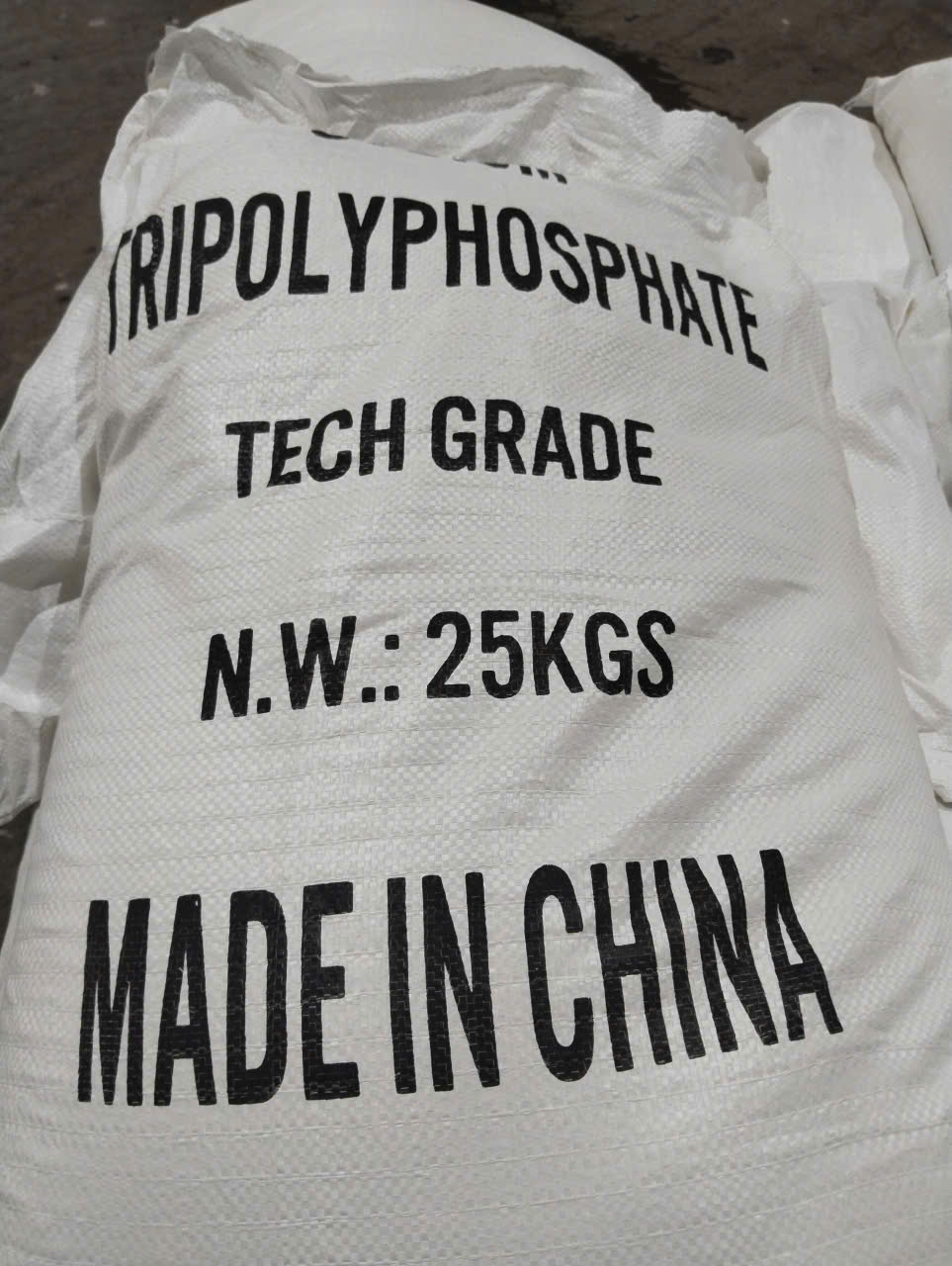

SODIUM TRIPOLYPHOSPHATE (STPP)
1. Product Overview
Sodium Tripolyphosphate (STPP) is an inorganic polyphosphate salt widely used in the ceramic industry as a highly effective dispersant (deflocculant). It plays a critical role in viscosity control and solid content optimization of ceramic slips and glaze slurries, significantly improving casting efficiency and final product quality.
STPP is an essential performance additive for modern ceramic production, enabling high efficiency, consistent quality, and optimized processing conditions.
2. Chemical Classification & Composition
- Chemical name: Sodium Tripolyphosphate
- Chemical formula: Na₅P₃O₁₀
- Chemical class: Inorganic polyphosphate salt
- Active species: Sodium ions (Na⁺) and tripolyphosphate anion (P₃O₁₀⁵⁻)
Deflocculation Mechanism:
- The tripolyphosphate anion adsorbs onto the surface of clay, ceramic, and glaze particles.
- Particle surfaces become strongly negatively charged.
- Electrostatic repulsion breaks down flocculated structures.
- Slurry viscosity decreases rapidly while maintaining high solids content.
3. Typical Technical Properties
|
Parameter |
Specification |
|
Appearance |
White crystalline powder, odorless |
|
Solubility |
Freely soluble in water |
|
pH (1% solution) |
Mildly alkaline: approx. 9.5 – 10.5 |
|
Chelating ability |
Strong sequestration of divalent metal ions (Ca²⁺, Mg²⁺) in hard water |
|
Efficiency |
Extremely high dispersing efficiency; typical dosage < 0.5% (based on dry solids) |
4. Key Functions and Benefits
- Powerful deflocculant for ceramic and glaze systems
- Enables maximum solid loading with low viscosity
- Improves slurry flowability and casting performance
- Reduces drying shrinkage and cracking
- Enhances density and reduces porosity of fired products
- Maintains slurry stability and uniformity during processing
5. Applications in the Ceramic Industry
5.1. Ceramic Body (Slip Casting)
- Primary dispersant for slip casting processes
- Produces highly fluid slips with solid content exceeding 70%
- Accelerates drying, reduces deformation, and improves green strength
- Ensures stable and controlled rheology for sanitary ware and tableware casting
5.2. Glaze Applications
- Prevents hard settling of glaze particles during storage
- Maintains homogeneous suspension in glaze slurries
- Improves dispersion of ceramic pigments (e.g. cobalt oxide, iron oxide)
- Ensures uniform color development and surface quality after firing
6. Usage Guidelines
- Typical dosage: 0.05 – 0.5% based on dry raw materials
- Overdosing may cause excessive deflocculation, leading to instability
- Best performance achieved when combined with proper milling fineness, slurry density control, and process optimization




Reviews
There are no reviews yet.